Subvert has an AI policy next to a “Report Content” link on every page. Very good!
What about Mirlo, Bandwagon, Jam.coop…? Do they have a policy, or has it been discussed?
Subvert has an AI policy next to a “Report Content” link on every page. Very good!
What about Mirlo, Bandwagon, Jam.coop…? Do they have a policy, or has it been discussed?
Yes we do
https://mirlo.space/pages/content-policy
Ampwall as well
https://ampwall.com/content-policy
Jam as well
Subvert was actually the last of all of those to write one ahah
Honestly I feel like pretty much everyone has one now, including Deezer, Tidal etc. so it’s really kind of a non event at that point, we all ask people to report content or report it ourselves.
I think the bigger question as catalogues grow is how do we check this, because as we mention in our own content policy, policing is work, and it’s work none of us like to do and can be extremely tiring (because it’s unseen by all, but it also includes responding to emails of people genuinely asking why we took down their work, and figuring out what to do if they claim it wasn’t made with AI, etc.). At which point the question of “automatisation” comes into play, and automatisation of policing online platform is always the first step of enshitification.
So I’d say the policy isn’t the problem it’s the “how” and the application of said policy that’s the real topic that’s not easily solved.
Ok, I see. Subvert is good at making visible statements. 
Today I saw a song I liked, published on Subvert and Mirlo. On Subvert it is clear when you upload that no AI is allowed and there is a link to report.
On Mirlo I see the policy prevents music “entirely created by AI”. This song had a lead singer made with Vocaloid (disclosed in the song description, kudos for the artist). Vocaloid is AI (nowadays). It looks like the rest was done without AI (at least not prominently). So I guess it is compliant with Mirlo’s policy.
I understand the work required to enforce the policy, but as long as the guidelines are clear and there is a link to report… It’s a bit like the Wikipedia model, where it is ok to have a wrong birth date of a medial aristocrat if the page doesn’t even get that much attention, but if the information gets more attention (like the music gets more attention) then it is good to allow users an easy way to at least report. Although handling reports is work too.
Yeah, it’s complicated. Maybe use AI to handle the reports? Just kidiiing.
While I am extremely against the use of AI I am also not entirely sure of the value of AI statements and, more importantly, the policing functions that AI statements burden fans and non-VC funded platforms.
AI is a cultural/social problem and more policing probably isn’t the solution.
This is a real conversation that communities are/should be having. Is an environment where fans are encouraged to also be a police conducive to the social connection we know music to promote? Do increased policing burdens change the kinds of people willing to undertake development of music platforms (and I think the Wikipedia example is particularly on the nose in this regard)? How will any potential report function or policy be abused by trolls/bots/competitors/jilted lovers/stalkers etc?
Purity test statements and policies are likely to result in greater burden, decreased positive vibes around music, and developer/admin burnout. Of course, increased slop is also going generate similar outcomes. But how it’s all handled might require a nuanced conversation.
Yes, all very good points, thank you. Let’s see…
It is good to have a policy or guidelines where a platform declares its scope in relation to the use of “AI” (a vague term for a clear policy, to start with) in the works published on the platform. As shown in the links above, we have this.
Then, given that fairness is the driver here, it would be fair to request / require to the artists to disclose their use of AI when they publish their music, just like there is a request / requirement to agree that the works are yours / that you have permission to publish them, and that you abide to a code of conduct that may restrict certain types of content.
For example, in my real example above, I was truly grateful that the creator had explained in the description that the voice was coming from a Vocaloid synth (even named which) while also describing the gear and software used for the rest. There is no need to show your kitchen (unless you want to) but it would be nice to encourage artists to disclose their use of AI, for fairness. Then, it is up to me as a listener to decide what to do with that information.
Being comprehensive in the credits of your music is also related to fairness. Back to the real example, I was interested by who was the singer, I looked at the credits, and then I saw the Vocaloid detail. Good.
The use of AI is likely to keep expanding and becoming even more sophisticated. Also the use of the term “AI” for marketing of tools than in some cases don’t even have much of “AI”. As you say, trying to police this, even if it would be sensible is going to be likely impossible. We can still rely on the willingness of the musicians / publishes to be fair and disclose their use of these tools. And well, common sense still plays a role. When someone comes out of the blue releasing albums every 10 days with impressive female voices and what not, also with the characteristic album covers, and in the end everything sounds good but… the same kind of “good”… the facts end up speaking by themselves.
Imo the Wikipedia comparison doesn’t really hold because it’s a very different type of data, and copyright isn’t as strong of an issue with Wikipedia (and Wikipedia contributors have their own policing problem and it’s a whole can of worm), but yeah, what you describe is closer to what I’d say Bandcamp is doing for now.
Otherwise yeah for example personally I wouldn’t feel right removing stuff made with Vocaloid, it’s an entire subgenre with lots of intricacies and great musicians within it that have existed for over 20 years, and if we start to need to have look into wether they’ve used Model 5 or Model 6, and then eventually ban Model 6, it starts to feel a bit weird to me, that’s really where blanket statements over these things crumble in my opinion.
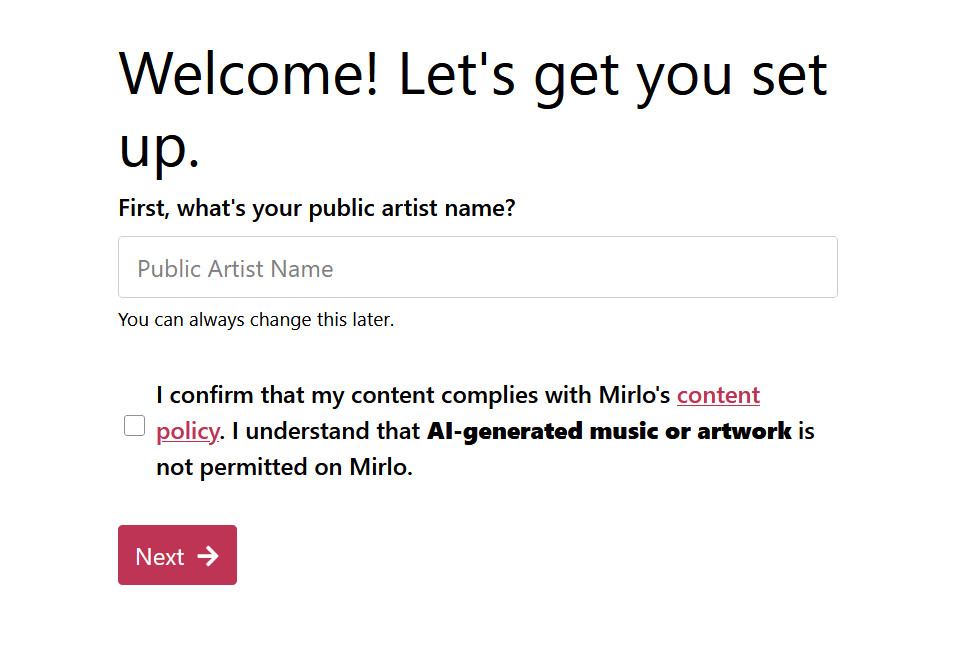
As for “making it visible”, I feel like this is pretty clear when an artist sets up their account?
We could obviously say so on every album upload page, but I also feel like at some point, if an artist ticked this on the way in, they know where they are and we should just trust them to some extent. (as a result, adding this toggle has indeed resulted in much less AI music being posted on the platform afterward)
I have been following genAI discussions across a few different spaces now and it is interesting to see the ebbs and flows of the conversations (and arguments that develop in some cases as well).
I really liked your comments here because I agree that statements are popping up all over the place and really policies, guidelines, etc. all of them need to take all the various actions they are prescribing or asking to be done and by whom. My real world example is from my professional life where we provide access to physical archival records and have the researcher sign a form that states they can only use it for research and must seek appropriate copyright clearance for when they want to publish using those records, etc. However, I cannot have my team chasing down each researcher and making sure that they obtained proper copyright clearance before they publish their book. My team would essentially never do anything else.
So, following the scenario above, I agree with @gahlord that policing functions put the onus on the community to do that work. Nor do I think that it is up to platform to do it, because it either leads to an automated system (which I could go on and on about how problematic they are) or it burdens a team of individuals to do those checks.
The second point I wanted to make is that especially statements can be problematic even with good intentions. As an example, here in Canada we currently have land acknowledgements for indigenous groups and communities that are provided at the beginnings of speeches, events, etc. while the intention is good, to acknowledge the systemic colonial tragedies and violence that has taken place, the statements without other reconciliation actions end up being nothing more than surface level. The reason I use this as an example is I think that @gahlord makes a good point that it is conversations that communities need to be having and discussing the constantly changing landscape of genAI in our creative environments. I see too much punching down, rather than working together to focus on the larger issues. Perhaps it is using our collective power to make changes where we can instead, or looking into what is possible there.
All in all I think that the moving target of genAI is so volatile that we would destroy ourselves attempting to police and enforce it to the level of a policy. It really is about building community and coming together for those important debates and discussions where we can really build up each other through knowledge and support.
The thing with Vocaloid is that while it’s using AI approaches these days, it’s not really representative of the same problems as AI in general. “AI” is an incredibly broad term that covers a lot of ground, and even generative AI has both good and bad expressions of it. Writing a definition that differentiates them is also super difficult.
Like, when you’re making a song with Vocaloid, there’s still human authorship, production, and decisions being made, and their models are trained ethically from data that they have all the rights to. They are not scraping every song on the planet and distilling it into the statistical mush of all music, and they are not plagiarizing other peoples’ content. They are also paying the people to provide the training data in the first place.
A similar situation occurs with SynthesizerV, where yes, their instrument models are technically generative AI, but it’s ethically-made and runs locally and is a tool being used by the musician, not something that takes over for one.
Trying to deal in absolutes always leads to more problems, and it’s super difficult to draw a line.
Suno and Udio are clearly bad, because there people are only providing prompts or maybe demo versions that it’s completely resynthesizing from whole cloth and using a corpus that was not ethically produced. It removes all skill and talent from the equation.
I don’t think the same can be said for Vocaloid, SynthesizerV, etc.
And it certainly doesn’t apply to Apple’s AI tools in Logic, which are just fancy loops (in the case of Session Musician) and a series of loss-reduction functions that drive mastering plugins (in the case of Mastering Assistant).
The focus should not be on whether AI was used, but whether the music was composed and produced ethically.
Personally, I’m glad my chosen platforms, Jam.coop and Mirlo.space have strict AI usage content statements. I am adamant that my art not be displayed along with AI slop. Full stop.
Just a final (?) note on Vocaloid and me. The comments above encouraged me to learn more about this software and the community around it. My current and very subjective conclusion is that Vocaloid and voice synthesis in general is fine by me when it is used as that, as voice synthesis, clearly audible. So far I’m feeling deceived when a synthetic voice just sounds like a real human singer. Then again, I recognize how inconsistent this thought / prejudice is after years of synthesized drums, pianos, violins and what not without physical instruments and without actual human drummers, pianists, violinists, etc behind. So yeah, it’s complicated. 
Mike Brock published an insightful piece in 2025 that seems relevant to this discussion. It’s called Democracy Needs Art, and it’s about the political function of auto-generated art.
"Today’s oligarchs have developed a more sophisticated strategy than old-fashioned censorship: they’re drowning authentic art in an ocean of synthetic content that triggers the same neural responses without the moral payload. Why ban the song that makes people feel collective power when you can bury it under ten thousand AI-generated alternatives?
The flood of algorithmic content occupies the aesthetic bandwidth where genuine art would otherwise create sustained moral attention. Every AI companion telling synthetic stories, every playlist of generated music, every feed of viral micro-content serves the same function: providing aesthetic stimulation without the transformative power that makes art dangerous to authoritarian control."
I fell like this is very important distinction, thank you for articulating this. It’s a nuance that is too often completely buried under the polarising issue, for which the Big Tech AI companies are completely to blame. (* imagine some expletives here *). But yeah, it’s actually true that technology of machine learning and more algos like neural networks and, i suppose, even GPT (a transformer) are not really the issue, but it’s all the sam altmans, musks, zuckerbergs of the world (and their followers with similar motives, like CEO of SUNO, etc…) who are completely disregarding any ethical consideration in pursuit of unregulated profit-making, it’s them who we need to fully reject and resist.
Wasn’t sure how to handle it. Fight it, or give it its own place? Fighting is a guaranteed loss at some point, just like bots, technology gets smarter.
So I got IRCAMamplify and all music uploaded gets scanned, if it scores high, the song and the artist get tagged as AI, don’t play in our radio or get suggested, and go into an AI category. You can also hide all AI from your side in settings.
Some stuff flags as AI because of AI mastering and samples, which is popular these days. As for the music? Some people like it, I think it’s junk, but to each their own. 
My main question really is how accurate is this at scale.
They offer their scanning only by request, it’s €120 for 2000 scans, and I will say it is pretty damn accurate. I have music on my platform that falls between multiple scores, and speaking with the artists about it in the past, I can tell who is using AI for mastering and who is using AI for composition. Makes it a lot easier to sort through and keep ahead of.
They offer a larger scale tear that is pay as you go, but since my platform is currently pretty small, I’m not there yet, €120 is enough money for me right now lol
Not really on the topic of policy, but on the subject of AI and distinguishing slop from human creations, human.json is an intriguing idea. Maybe music platforms could be a testing ground for this?
Interesting idea in principle, but this is not so different from webrings or the good old “Links” section on any other website.
Actually i kinda hate that this is made in reaction to AI slop, because at its core it’s a trust principle that could extend to many other situations: realiable source of information, interest-adjacent content etc…
Now imagine a company using it on all its properties : choose to trust one of them for a signle reason, and suddenly a web of unrelated “trusted” sites pollute your trust circle with second-hand and third-hand trust points.
Maybe this is a good way to do it. Instead of focusing on AI, we may prevent uploads of music that was unethically produced.
Which brings the question of “ethical production and composition”. What would that look like ?
Maybe, uh, something like “Every party involved should have given their enlightened consent to the publication of this track.” which would imply AI training should be made on ethically sourced samples.
That feels like it gets to the gist of it, yeah.
As I evolve my thoughts, I keep coming to this:
If you happen to use AI (something that is becoming increasingly hard to verify) or you even disclose it and you are a solid community member… Well, this is very different (to me) than if you use AI for your music and all you care is about plays, likes, followers, and revenue.