Firstly, good on you for giving this a go! You’re not only putting your unpaid time into this, but also money out of your own pocket, in the hopes of creating something useful to music communities. I think it’s important to recognise and appreciate that. Regardless of any opinions we might have about this or that.
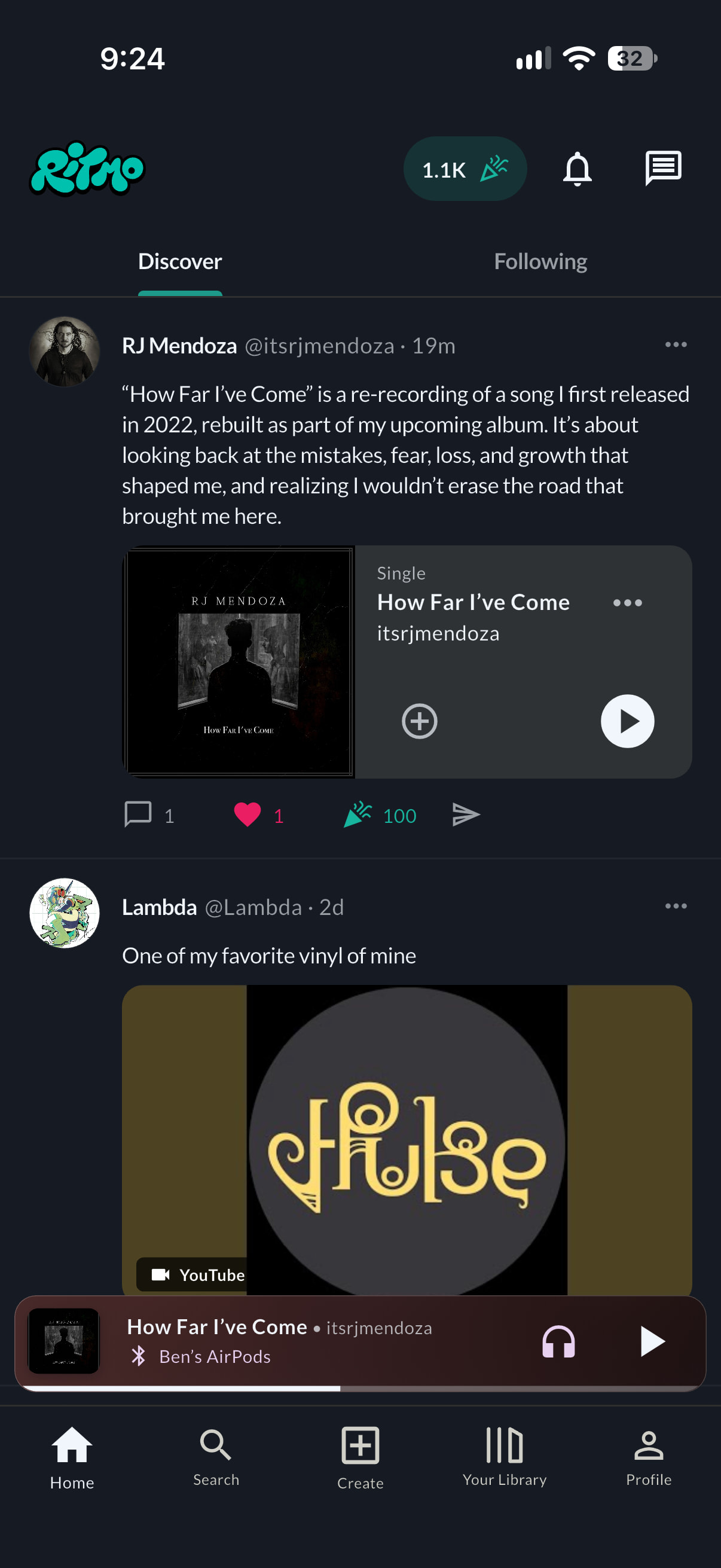
Ok, so this is a point of difference. Ritmo works by having artists upload their music there, yes? But most of the music hosting projects represented here seem to start their design with the artist experience. Ritmo’s design approach is maybe more similar to @TheIndieBeat, FairPlayer (@txels), or SubJam (@Jordan), in prioritising the audience experience.
This points to one of the benefits of a federated approach; artists can choose a music host whose interface is designed primarily around their needs, while knowing that their music can be found (with attribution, back-links, and ideally opportunities for financial support) via apps that prioritise the needs of audiences.
This is a modest but useful goal, measurable, and almost certainly achievable. I like this. Do you have a timeframe in mind for when you’d like to reach this milestone (I’m a big fan of SMART goals)?
Keep in mind that this makes Ritmo more attractive to audiences than to artists. Because if you shut up shop, for whatever reason, people can find music elsewhere. Whereas artists could lose an important tool in their workflow.
If an artist doesn’t care who owns the platforms their distribution and income depend on, they’ll probably stay on BrandCramp, BeatPort etc. Those willing to take a punt on independent services tend to be looking for artist-orientated stewardship, social enterprise or platform co-op models, etc.
Not at all. I suggest having a browse of some of the discussions about this around the forum. We’ve talked a lot about what kinds of interoperation might be useful for artists and audiences, pros and cons, technical options, etc.
One way to approach interop design is to ask; how could the artists/ listeners using my service benefit from being able to interact with people using accounts on other independent services? Which features to federate, in which order of priority, and which protocols to use to do it, will depend on the answers you come up with. Here’s a few ideas off the top of my head.
Publishing over RSS
The low hanging fruit is to publish some data over RSS. So for example, when an artist publishes a new release, someone could receive a notification of that in a feed reader or podcast app.
Streaming over Chorus
You could also look into implementing the Chorus protocol, currently being developed by our own @fluffy, so that music by artists hosted on Ritmo could be discovered by people using FairPlayer (@txels, @fluffy please correct me if I’ve misunderstood!). Listeners using Ritmo might appreciate being able to discover music hosted elsewhere, so you could look at FairPlayer’s code as an example of using Chorus to enable that.
Joining the musicverse with ActivityPub
I’m a big fan of ActivityPub, which can be thought of as RSS+Replies. If you have any social features on Ritmo, some of them could be federated over AP. For example, take a feature like allowing listeners to follow an artist when they enjoy a song, to get notifications when the artist releases new music. That could be opened up to other service by publishing over RSS, as above.
But if you did it by federating over AP, listeners on other services could Boost a release post, making it more discoverable in their social network (which could include people from many different services following their account). They could also post comments or reviews as Replies, which the artist could choose to display on their release page. FunkWhale and @bandwagon were built around AP federation, but @mirlo started adding this functionality after their initial build. Hopefully other music hosts will look at doing the same.
Warning: here be dragons. Discussions here have made me even more painfully aware of how complicated AP can be to understand and use. It was designed to be the core plumbing for a social web, so it’s very generic, and the language of the specs can be very abstract. I definitely recommend learning more about it (if you haven’t already), but it may or may not the best place to start working towards interop.